Foreign Policy, August 4, 2010
“I hate the Chinese propaganda machine so much,” says Zhang Hongtu, the famous Chinese-American painter, as he pulls up a stool in his studio in Queens, New York. Two years ago, he butted heads with government censors, when he tried to bring a controversial painting into China as part of a 2008 exhibit organized by the German Embassy in Beijing. Customs officials seized his Cubist-style depiction of the Olympic “Bird’s Nest” stadium, which was inspired by news of Tibetan exiles protesting along the Olympic torch relay route, and contained the words “Tibet,” “One World, One Dream,” and “human right.” (Officially, the problems enumerated by officials, as Zhang recounts, were: “1. The colors of the painting are too dull. 2. The image of the Bird’s Nest is no good. 3. The words on the painting are not acceptable.”) Eventually, the confiscated painting was released in Taipei, where Zhang retrieved it. “I was disappointed, but not surprised,” he says.
Pushing limits is nothing new for Zhang, a Hui Muslim, born in a small town in western Gansu province in 1943. He moved to United States in 1982, frustrated by limitations on thought and expression, and dispirited by the Cultural Revolution. “I loved Mao,” he says, with a momentarily wistful look in his eye. “Then I was very, very disappointed by Mao.” He explains that it’s difficult for outsiders to grasp how profound was the disillusionment and sense of loss for Chinese artists and intellectuals who came of age during a time when Mao’s promise of a new national beginning, after years of civil war, initially inspired tremendous hope. But Zhang’s art has never been straight-forward political protest: His iconic image of Mao Zedong on a Quaker Oats canister, one of a series of wry, send-up Chairman Mao portraits completed in response to Beijing’s denial of the 1989 Tiananmen massacre, is today famous around the world as a clever indictment of Chinese propaganda. “I try to raise questions with my art — I do not often know the answers.”
Zhang’s strategy of provocation through playful juxtapositions and uneasy conflations defines his three-decade career. After his Chairman Mao paintings, he went on to fashion McDonalds’-style hamburger and french fry containers in the oxidized bronze style of ancient Han dynasty artifacts and Ming porcelain Coca-Cola bottles. One of the first Chinese artists to warn of the nation’s penchant for consumerism, he says, “If more than a billion people care only about money and materialism, it is big trouble.” He then taught himself to paint in styles reminiscent of Van Gogh, Monet, Manet, Picasso, and Cezanne, turning centuries of classical representations of Chinese landscapes and rivers into wild Starry Nights and serene Water Lilies. “At first, both sides — Eastern and Western art critics — hated it, but now I have so many orders to my gallery for this style of work that I cannot keep up. My point is to show how cultures mix.”
In 2008, Zhang returned to more politically minded art, his most controversial collection since the Mao portraits. The twelve paintings in his “Shan Shui” (mountain, water) series tackle another troubling legacy of recent Chinese history — not Beijing’s efforts to stamp out so-called “spiritual pollution,” but the environmental costs of actual pollution. “Today the countryside is dying, and this is great threat to Chinese people,” he says.
As a boy, Zhang traveled widely across China, especially during the period of China’s civil war, when his family was forced to move frequently, from Xi’an to Shanghai, Suzhou to Nanjing. In the 1960s, he remembers swimming in the cool, clean waters of the Yangtze River. “Now it is too dangerous even to touch,” he says, recalling an unpleasant encounter from a recent trip. “This is the reality today, black rivers and no fish.”
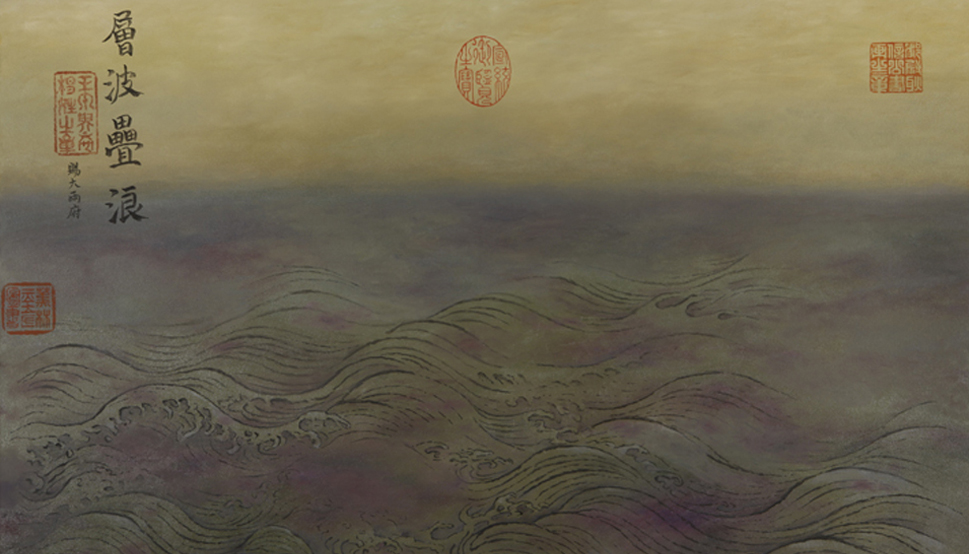
To evoke the startling transformation of the landscape of his childhood, Zhang turned for inspiration to a famous series of paintings by 12th century artist Ma Yuan. Ma’s dreamy evocations of rivers and mountains, such as “Scholar by a Waterfall,” remain quintessential depictions of China’s countryside — known to every Chinese schoolchild, just as Mark Twain’s novels or landscapes by the Hudson River School artists are familiar in American classrooms. Ma’s “Walking on a Path in Spring,” for instance, now hangs at the Palace Museum in Beijing.
Zhang’s adaptations of these classics use similar brushstrokes, but the rivers show the effects of industrial pollution and agricultural diversion: some have turned bright green or are covered with a sheen of chemicals, others have dried up entirely. “I wanted to keep some of original line work, but show the change … the pollution of water, and the shortage of water.”
Click here for Foreign Policy slideshow of Zhang’s paintings.
 Christina Larson